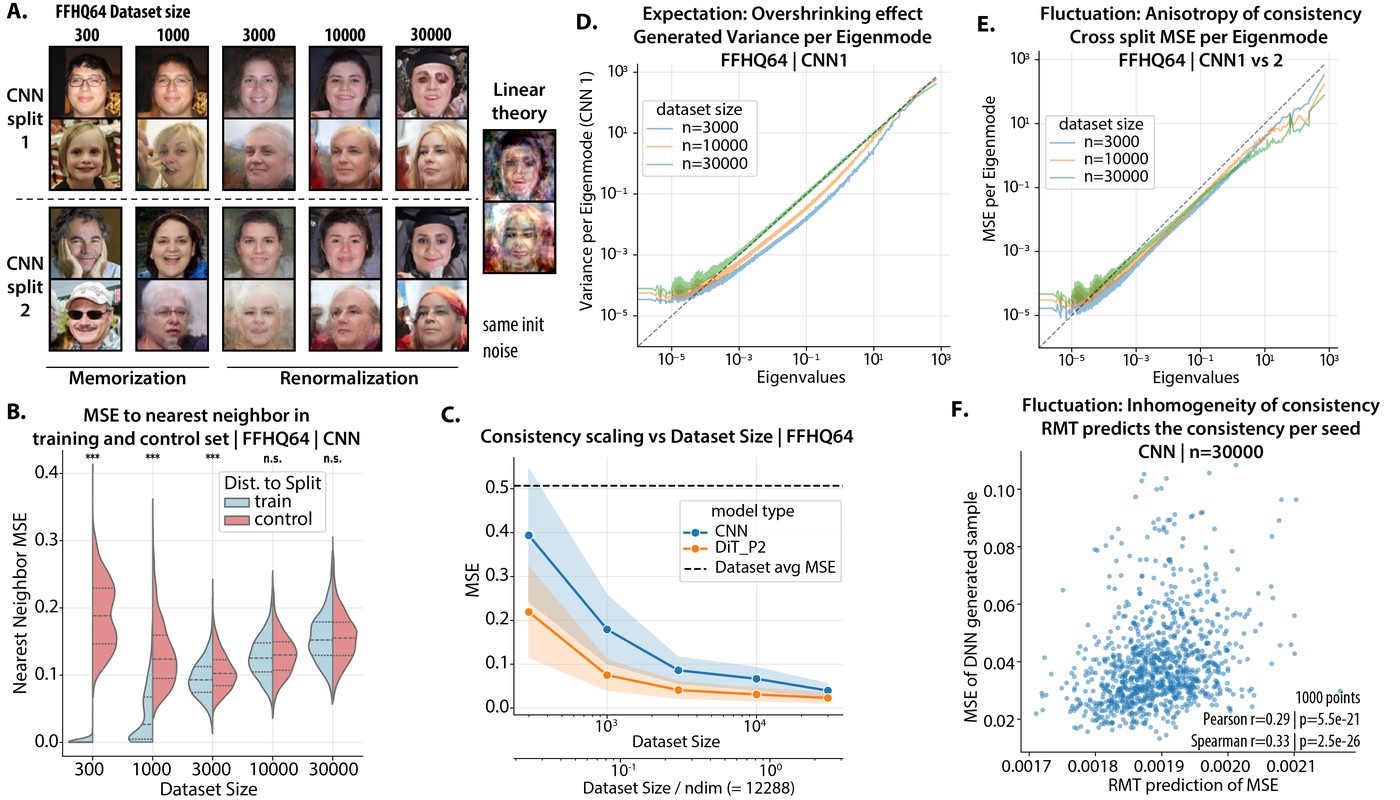
Train two diffusion models on completely different halves of a dataset. Give them the same noise seed. They produce almost the same image — across data splits and across architectures (UNet, DiT). We show this consistency is largely a linear effect — the shared Gaussian statistics already predict the output — and build a random matrix theory that says precisely where and how much independently-trained models will disagree.
Train two diffusion models on disjoint halves of a dataset and sample both from the same noise seed. The outputs are nearly identical — across splits and across architectures. Why should two models that never saw the same image agree? Here is the linear intuition.
Empirical Gaussian statistics — the first two moments
Both the linear denoiser $\mathbf D^*$ and the sampling map $\mathbf x^*$ depend on the data only through $(\hat\mu,\hat\Sigma)$. Across independent splits these first two moments barely change — so the maps barely change, and the generated samples come out consistent. Under high noise and in the generalization regime, deep diffusion models reduce to this same linear / far-field solution, which is why it predicts them.
Explore it yourself. Pick a dataset and a noise seed. Split 1 and Split 2 are independent models trained on disjoint data; Linear theory is the closed-form Gaussian (Wiener-filter) predictor above, using only each split's $(\hat\mu,\hat\Sigma)$. The outer rows show each split's nearest training images — note the samples are not copies of them.
Takeaway. Cross-split and cross-architecture outputs are closer to each other than to the nearest training image — this is generalization, not memorization — and the linear predictor already calls the shot.
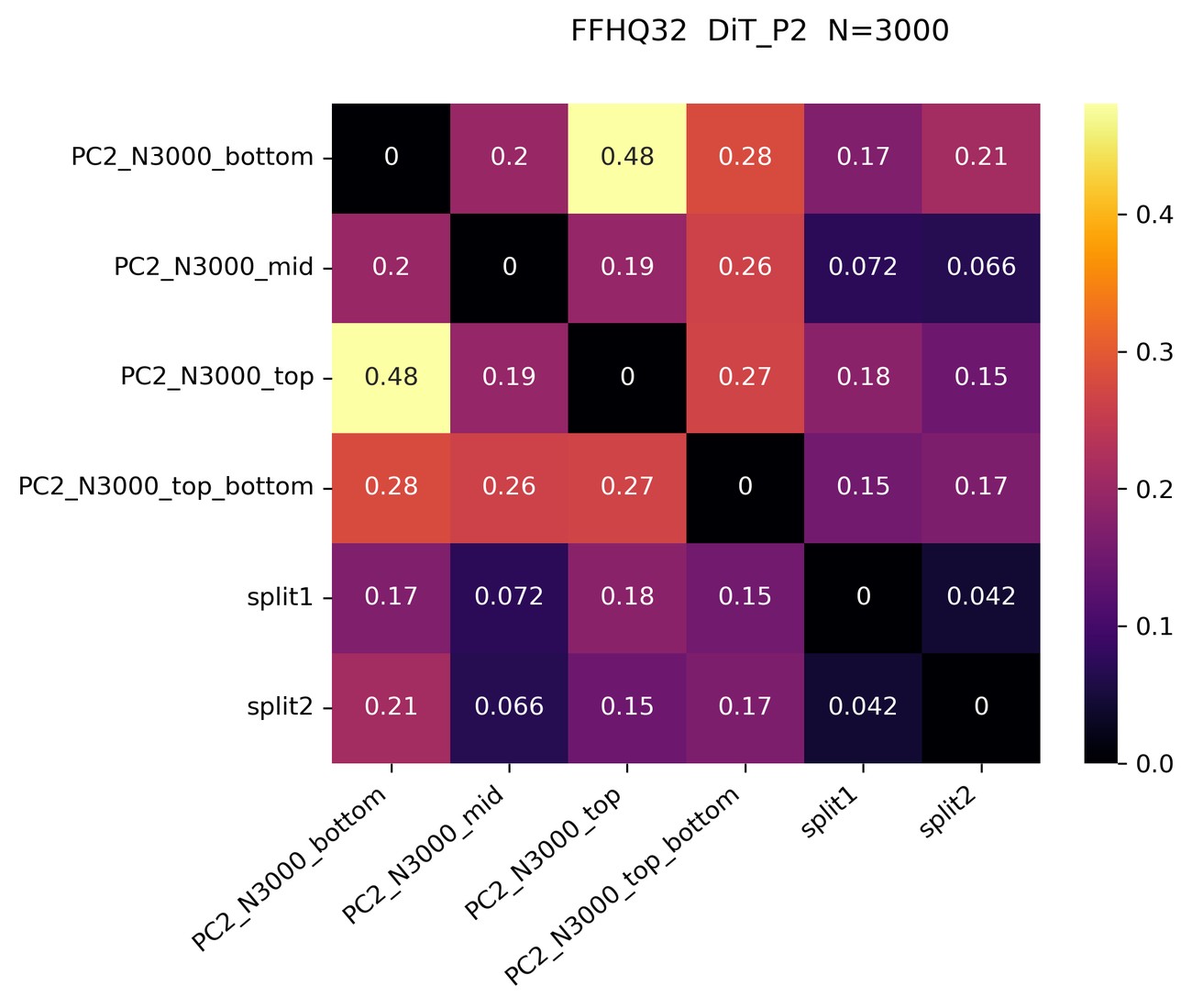
If consistency really comes from shared $(\hat\mu,\hat\Sigma)$, then forcing the splits to have different moments should destroy it. We stratify the data along a principal component (PC2) into top, bottom, and mid groups — deliberately mismatching the mean and covariance across "splits."
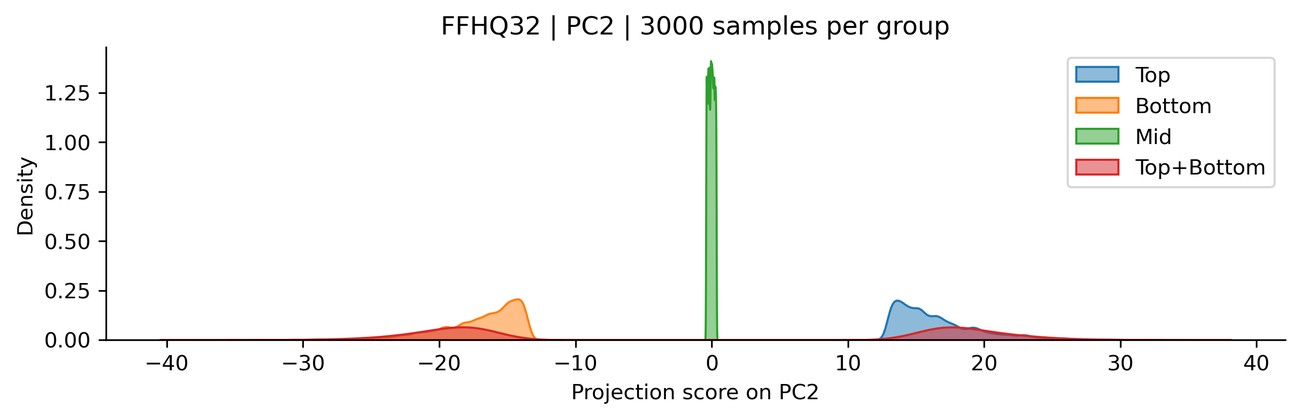
The linear theory is therefore a necessary condition: when Gaussian statistics differ, even deep networks stop being consistent.
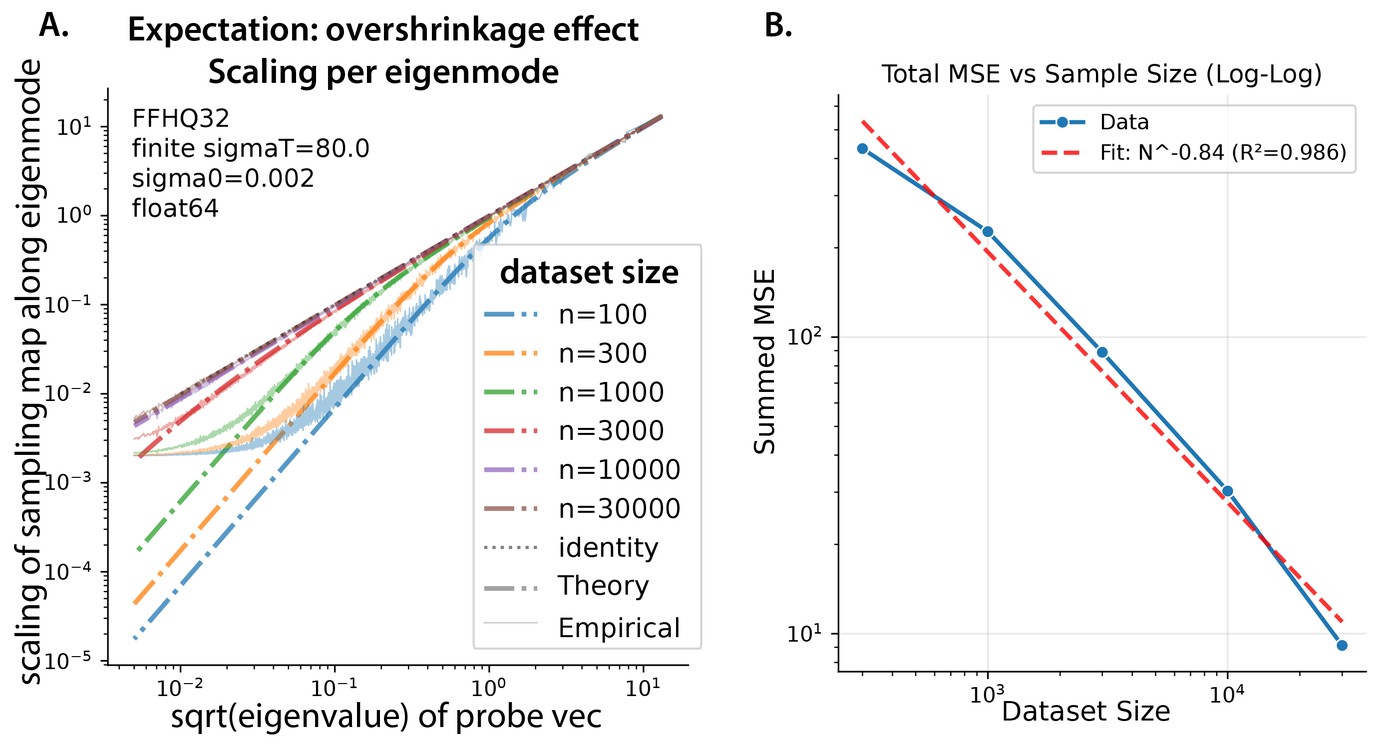
Slide the training-set size $n$. With little data, models memorize and reproduce training images. As $n$ grows they generalize, and finite-data shrinkage pulls samples toward the dataset mean — textures and backgrounds smooth out (the "average-image" effect).
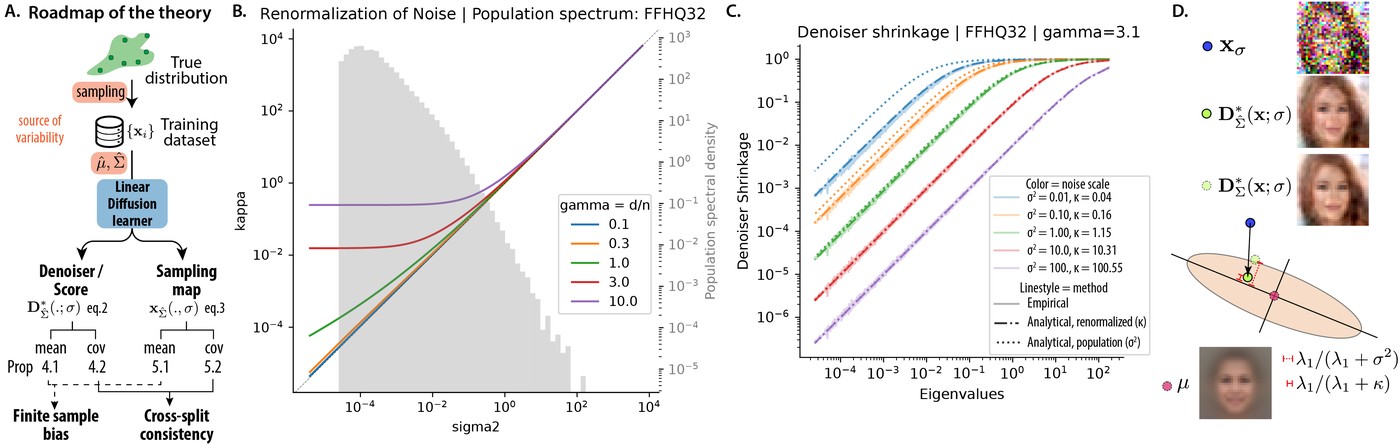
All finite-sample effects on the average denoiser collapse into a single scalar knob: the renormalized noise scale $\sigma^2 \mapsto \kappa(\sigma^2)$, the unique solution of a Silverstein self-consistency equation set by the data spectrum and the aspect ratio $\gamma=d/n$. Because $\kappa(\sigma^2)\ge\sigma^2$, the model behaves as if the noise were larger — so low-variance modes get over-shrunk toward the mean.
The mapping bends up most at small noise and large $\gamma$ — exactly the regime of fine image detail with limited data. So high-frequency details need more samples to be reproduced consistently.
Spectrum used here is a representative heavy-tailed natural-image spectrum (power-law). The true per-dataset spectrum can be swapped in.
Finite data act as if the noise were $\kappa(\sigma^2)\!\ge\!\sigma^2$ — an adaptive ridge.
The population denoiser, but with $\sigma^2$ replaced by the larger $\kappa(\sigma^2)$: low-variance directions are pulled toward the mean.
Disagreement factorizes into which direction (anisotropy), which input/seed (inhomogeneity), and how much data (scaling). Here $\Diamond(\mathbf u,\kappa,\Sigma)=\mathbf u^\top(\Sigma+\kappa I)^{-2}\Sigma\,\mathbf u$.
A new tool that extends deterministic equivalence to $\Sigma^{1/2}$, so the entire sampling map (not just one denoising step) becomes analyzable in closed form.
The linear RMT predictions extend qualitatively to real UNet and DiT diffusion models. The same memorization→renormalization transition appears; cross-split deviation shows the predicted anisotropy across eigenmodes; and — using only the population covariance and $n$, with no knowledge of architecture or split — RMT predicts which seeds two models will disagree on (Spearman $r=0.33$).
The repository ships rmt_core — a reusable toolkit for the deterministic-equivalence
machinery used here: a robust solver for the Silverstein equation $\kappa(z)$, degrees-of-freedom
functions, the fractional-power integral identities, and linear-denoiser / Wiener-filter utilities —
plus curated example notebooks reproducing the key figures.
@inproceedings{wang2026rmtconsistency,
title = {A Random Matrix Theory Perspective on the Consistency of Diffusion Models},
author = {Wang, Binxu and Zavatone-Veth, Jacob A. and Pehlevan, Cengiz},
booktitle = {International Conference on Machine Learning (ICML)},
year = {2026},
note = {Oral presentation},
url = {https://arxiv.org/abs/2602.02908}
}